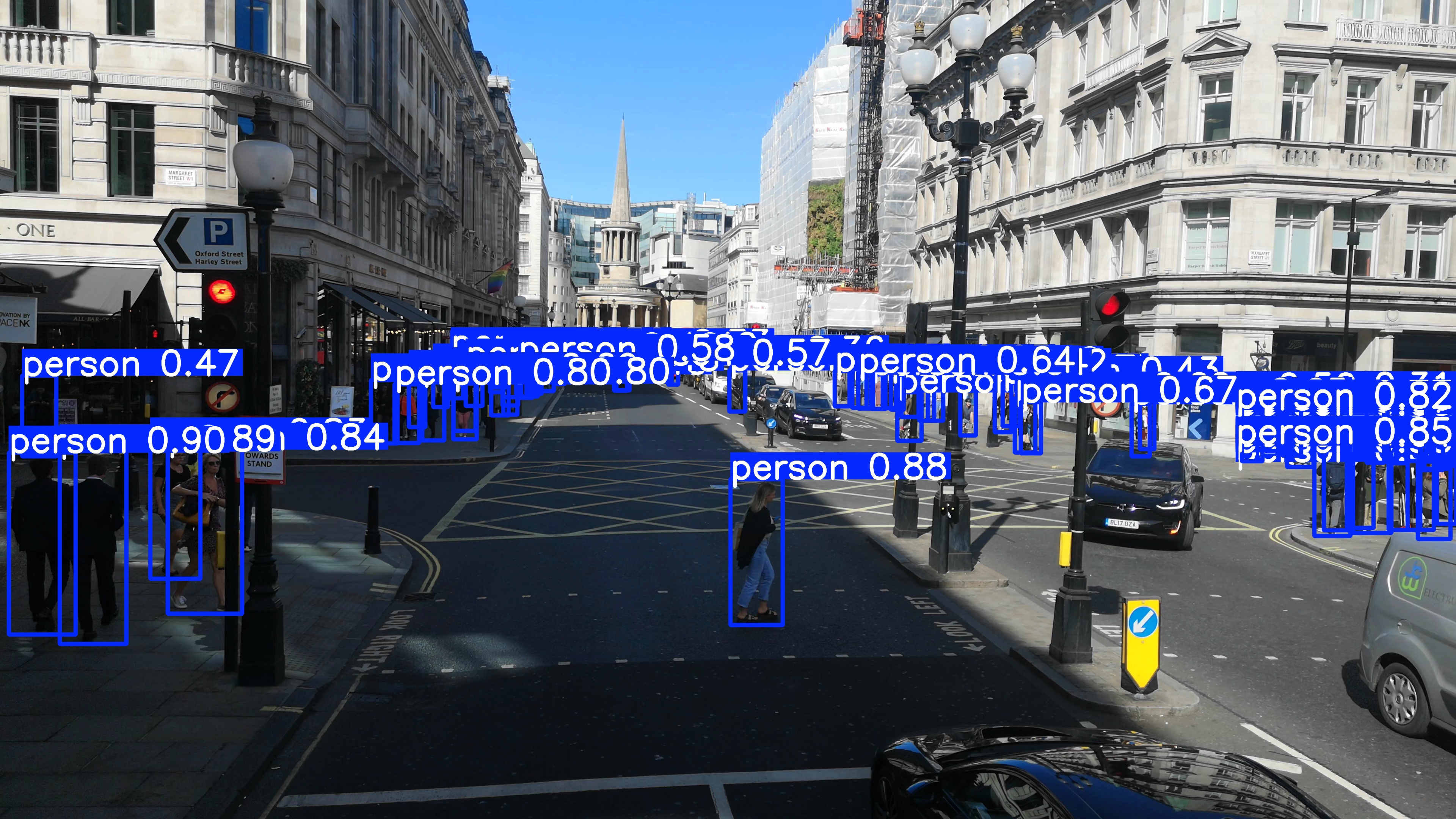
CrowdHuman-trained model on a street-video frame. Boxes show predicted pedestrians and confidence scores; this is a qualitative example.
View full size ↗Jetson inference: 34.4 → 9.6 ms with FP16 TensorRT (512 × 512 input).
COMPUTER VISION / EDGE AI
Pedestrian Detection & Edge Deployment
Code & evaluation results ↗3.6× faster inference · 34.4 → 9.6 msJetson Orin Nano · 512 × 512 input · mAP50–95 maintained at 0.211
I trained six YOLOv8m detectors and compared how they transferred across datasets, then deployed a model on an NVIDIA Jetson Orin Nano.
My work: model training, cross-dataset evaluation, and Docker/TensorRT deployment.
Evaluation & deployment details
Ran 24 evaluations across a 6-model × 4-domain matrix using precision, recall, mAP50, and mAP50–95.
The CrowdHuman-only model reached 0.246 mAP50–95 on 10,000 BDD100K images. This was the strongest BDD100K result among the six training strategies tested. Transfer performance depended on the direction of the dataset shift.
For the Jetson deployment, FP16 reduced 512 × 512 inference latency from 34.4 ms to 9.6 ms while preserving 0.211 mAP50–95.